
Facial contouring technology explained clearly is something surprisingly few resources bother to do. Most people assume facial contouring refers to a single procedure, perhaps a filler injection or a tightening device, when in reality it is a broad category of techniques targeting entirely different anatomical concerns. Whether you are exploring non-surgical facial contouring options for the first time or trying to make sense of the latest clinical advances, understanding how each technology works and why it is chosen matters enormously. This guide covers the mechanisms, the evidence, the risks, and the practical steps to help you make genuinely informed decisions.
Table of Contents
- Key takeaways
- Facial contouring technology explained: the anatomical foundations
- How does facial contouring work: key technologies
- Safety, risks, and what to watch for
- The latest in facial contouring: trends and what has changed
- Choosing the right approach: practical guidance
- My perspective on why this complexity actually matters
- Explore advanced facial contouring devices at Glowera
- FAQ
Key takeaways
| Point | Details |
|---|---|
| Contouring is not one treatment | Facial shaping technology spans injectables, energy devices, and manual techniques targeting different causes. |
| Anatomy must come first | Effective treatment starts with assessing bone structure, fat, muscles, skin quality, and symmetry individually. |
| Layered plans outperform single treatments | Combining volume restoration, muscle modulation, and skin tightening produces more consistent, natural results. |
| Safety requires qualified providers | Contraindications, technique errors, and overfilling risks make practitioner expertise non-negotiable. |
| At-home devices offer real support | Microcurrent and radiofrequency tools can complement clinical treatments when used correctly and consistently. |
Facial contouring technology explained: the anatomical foundations
Before selecting any technology, it helps to understand why facial contour changes in the first place. The face loses definition for several distinct reasons, and each one responds to different treatments. Grouping them under one umbrella is where many people go wrong.
The main contributors include:
- Volume loss: Bone resorption and fat pad atrophy reduce the structural scaffolding beneath the skin, causing hollowing around the temples, cheeks, and under-eye area.
- Skin laxity: Collagen and elastin decline with age, sun exposure, and lifestyle, leading to sagging along the jawline and neck.
- Muscle bulk or activity: Overactive masseter muscles can widen the lower face; conversely, weakened facial muscles contribute to drooping.
- Fat redistribution: Fat pads descend with gravity and accumulate in unwanted areas such as the jowls while depleting from the midface.
- Weak chin or jaw projection: Structural under-projection of the chin or jaw affects overall facial balance even without significant ageing changes.
Assessing all five factors before selecting any treatment is what separates a genuinely personalised plan from a trend-driven one. Bone support, skin quality, symmetry, and muscle activity all require separate consideration. Treating only one layer while ignoring the others is a reliable path to unnatural or short-lived results.
Pro Tip: Ask any provider to walk you through their facial assessment process before agreeing to a treatment. If they skip this step or move straight to recommending a single product, that is a meaningful red flag.
How does facial contouring work: key technologies
Understanding facial contouring means understanding its three main technology categories. Each works through a distinct mechanism and suits different concerns.
Injectables: volume and muscle modulation
Hyaluronic acid (HA) fillers restore lost volume and add structural definition. They are placed strategically in areas such as the temples, cheeks, jawline, and chin to rebuild scaffolding and improve proportions. Modern HA formulations vary in viscosity, which is how thick or fluid they feel, allowing precise placement at different tissue depths.

Botulinum toxin works differently. Rather than adding volume, it temporarily relaxes targeted muscles, making it useful for slimming a wide jaw caused by masseter hypertrophy or reducing the appearance of a downturned mouth. Botulinum toxin requires careful patient selection and skilled technique to avoid complications such as ptosis (drooping eyelids) or asymmetry.
Energy-based devices: tightening and collagen stimulation
Radiofrequency (RF) devices deliver controlled heat into the dermis and subdermal tissue, stimulating collagen remodelling. High-Intensity Focused Ultrasound (HIFU) targets the deeper SMAS layer (the structural foundation of the face) with focused acoustic energy. Both collagen-stimulating technologies are non-surgical, require a treatment series rather than a single session, and produce gradual results over several months. Microcurrent devices use low-level electrical current to re-educate facial muscles and improve tone, which you can read more about in Glowera’s breakdown of microcurrent skincare benefits.
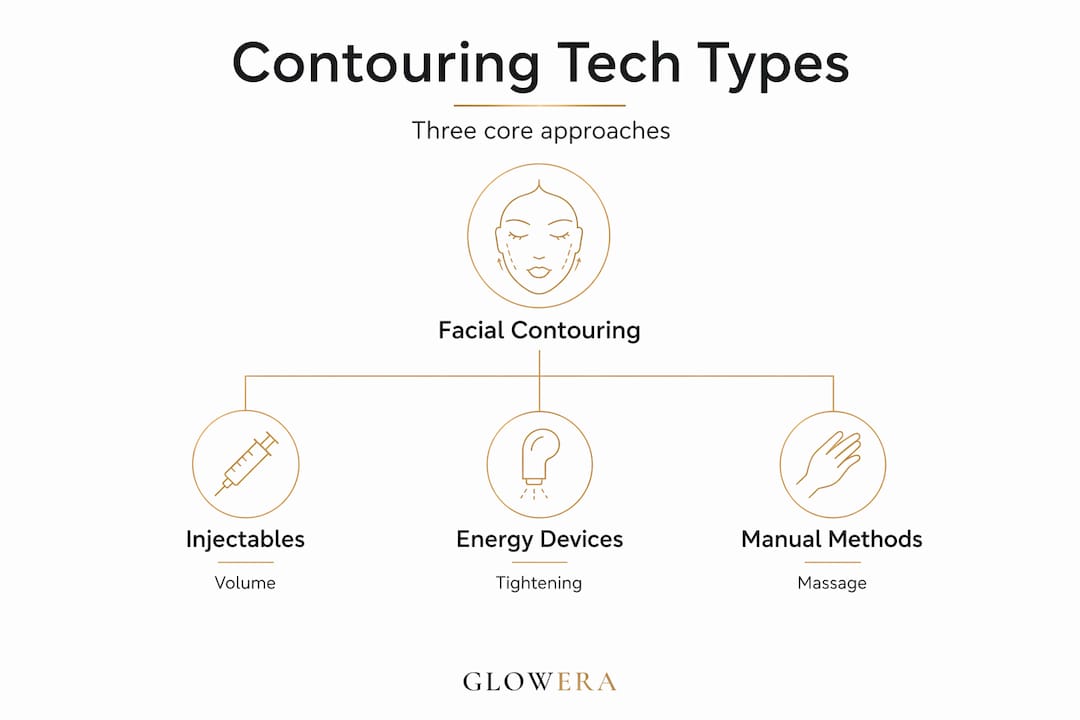
Manual techniques: the honest picture
Gua sha and facial massage generate genuine interest, and they do deliver some real, if temporary, benefits. The de-puffing effect most users notice reflects fluid shifts and mild muscle relaxation rather than any permanent structural change. Gua sha’s contouring effects are transient, and claims around collagen stimulation lack robust clinical evidence. That does not make these tools worthless. They can support circulation and product absorption. The key is calibrating expectations correctly.
| Technology | Mechanism | Result duration | Suitable for |
|---|---|---|---|
| HA fillers | Volume addition and structural support | 12 to 18 months | Hollowing, projection, definition |
| Botulinum toxin | Muscle relaxation | 3 to 6 months | Jaw slimming, brow lifting |
| Radiofrequency | Dermal heating and collagen induction | 12 to 24 months | Skin laxity, jawline tightening |
| HIFU | Focused ultrasound to SMAS layer | Up to 18 months | Deep tissue lifting |
| Microcurrent | Electrical muscle re-education | Cumulative with regular use | Muscle tone, facial definition |
| Gua sha | Fluid drainage and muscle relaxation | Hours to days | De-puffing, circulation support |
Pro Tip: For best results from energy-based devices, schedule treatments before adding fillers to the same area. Applying heat over fresh injectable product can affect placement and result quality.
Safety, risks, and what to watch for
Advanced facial contouring methods carry real risks, and these deserve an honest examination. Most side effects with both injectables and energy devices are mild and temporary. Bruising, swelling, and tenderness after injections are expected and typically resolve within one to two weeks.
Serious complications are less common but not negligible. With botulinum toxin, contraindications include pregnancy, active skin infection at the treatment site, and neuromuscular disorders such as myasthenia gravis. Technique is also critical. Injecting into the wrong muscle or at the wrong depth can cause ptosis or asymmetry that may persist for months.
Injectables carry the more significant concern of facial overfilled syndrome (FOS), a condition arising from cumulative excessive filler use. The result is a bloated, unnatural appearance that no longer responds to normal facial movement. FOS management depends on severity and may involve dissolving existing filler with hyaluronidase or, in resistant cases, micro-liposuction. The most effective approach is prevention through ongoing practitioner-patient communication.
Practitioner screening matters as much as the treatment itself. Verify that your provider is medically qualified, trained specifically in aesthetic procedures, and operates in a regulated clinical setting. A consultation focused on what not to do is often more reassuring than one that simply sells you a treatment.
The following factors should prompt you to pause or consult a physician before proceeding:
- Active skin infections or inflammatory conditions in the treatment area
- Pregnancy or breastfeeding
- Diagnosed neuromuscular disorders
- Blood-thinning medications that may increase bruising risk
- History of abnormal scarring (keloid formation)
The latest in facial contouring: trends and what has changed
The field has moved decisively towards precision and naturalness. The most significant development recently is the FDA approval of Restylane Contour for temple hollowing correction. In clinical trials, 91% of patients responded positively at three months, and 98% rated their results as natural-looking. What makes this notable is the dual-layer needle and cannula technique used for placement, which allows the filler to move naturally with facial expression rather than sitting rigidly beneath the skin.
| Trend | What it means in practice |
|---|---|
| Cause-led treatment sequencing | Providers address structural support and projection first, then tighten skin, rather than layering product at random. |
| Hybrid modality plans | Combining injectables with RF or HIFU in a planned sequence improves naturalness and longevity. |
| Improved filler mechanics | Newer formulations designed for movement rather than static volume, reducing the overfilled look. |
| At-home device integration | Microcurrent and RF home devices increasingly used between clinical appointments for ongoing maintenance. |
The shift away from maximalist filler use is real and clinically supported. Layered, cause-based treatment plans that combine volume restoration with muscle modulation and skin tightening consistently outperform single-modality approaches for both natural appearance and result durability.
Choosing the right approach: practical guidance
Good decision-making in this space follows a clear sequence. Whether you are considering professional treatments, at-home devices, or a combination, these steps give you the best foundation.
-
Start with a thorough facial assessment. A qualified provider should evaluate bone structure, fat distribution, muscle activity, skin quality, and symmetry before recommending anything. If this step is skipped, the treatment plan lacks a proper basis.
-
Ask specific questions before committing. How will this treatment address my specific concern? What is the realistic timeline for results? What are the risks with my particular anatomy? What is the maintenance schedule?
-
Understand realistic timelines. Fillers show results within days; RF and HIFU results emerge gradually over two to three months as collagen remodels. No technology produces instant and permanent outcomes simultaneously.
-
Consider at-home devices as consistent maintenance tools. Professional-grade home facial devices can extend the benefits of clinical treatments between appointments, particularly microcurrent devices used regularly for muscle tone and circulation.
-
Avoid common pitfalls. The three most frequent mistakes are pursuing the same treatment as someone else rather than addressing your own anatomy, accumulating excessive filler volume over time without reassessment, and skipping safety screenings to save time.
Effective facial contouring requires cause-led treatment plans rather than selecting treatments by popularity alone. A jawline treatment that works well for volume loss looks very different from one designed to address skin laxity, even though both target the same area.
Pro Tip: Request before-and-after photographs from your provider that specifically show patients with similar anatomy and concerns to yours. Generic portfolio images tell you much less than comparable cases.
My perspective on why this complexity actually matters
I have spent years following developments in facial contouring technology, and the single most consistent pattern I observe is this: people who go into treatments with clear anatomical understanding consistently report better outcomes and higher satisfaction than those who simply chase a result they saw online.
The complexity behind facial shaping technology is not a barrier. It is actually reassuring, because it means there is a logical, structured way to address your specific concerns rather than a one-size-fits-all protocol. The worst cases I have come across share a common thread: treatments chosen by trend rather than anatomy, often combined with inadequate consultations and unrealistic timelines.
What I have found genuinely useful is thinking about the face in layers. Bone and structure first. Fat and volume second. Muscle activity third. Skin quality fourth. Approaching contouring in this order, whether clinically or at home, keeps the process grounded in what the face actually needs rather than what is fashionable.
The growth of quality at-home technology means that the gap between professional and home care is narrowing. That is genuinely good news for anyone who wants consistent results without constant clinical visits. But it does not replace the foundational assessment that every good treatment plan requires.
— Adam
Explore advanced facial contouring devices at Glowera
Glowera offers a curated selection of professional-grade facial technology devices that complement any contouring routine. From radiofrequency and microcurrent tools to LED therapy and K-beauty tech, each device in the collection is chosen for its clinical backing and real-world performance. The Medicube AGE-R Ultra Tune 40.68 combines RF and microcurrent delivery in one device, making it a practical option for home-based skin tightening and tone improvement. For a broader view of what K-beauty technology offers for facial definition and skin health, browse Glowera’s full range of K-beauty tech devices. All devices are authenticated, with detailed usage guides and support from the Glowera team throughout the UAE.
FAQ
What is facial contouring technology?
Facial contouring technology refers to the range of clinical and device-based methods used to reshape, define, or restore facial structure. This includes injectables such as HA fillers and botulinum toxin, energy-based devices like radiofrequency and HIFU, and at-home tools including microcurrent devices.
How does non-surgical facial contouring work?
Non-surgical facial contouring works by targeting different tissue layers without incisions. Fillers restore volume, energy devices stimulate collagen and tighten skin, and microcurrent tools re-educate facial muscles. Most approaches require a series of treatments rather than a single session.
What are the main benefits of facial contouring treatments?
The main benefits include improved facial definition, restored volume in areas affected by ageing, reduced skin laxity, and a more balanced overall appearance. Layered treatment plans that address multiple causes simultaneously deliver the most consistent and natural-looking outcomes.
What are the risks of facial contouring procedures?
Common risks include bruising, swelling, and temporary asymmetry. More serious concerns include botulinum toxin complications in patients with neuromuscular contraindications, vascular occlusion with fillers, and facial overfilled syndrome from cumulative excessive filler use. Choosing a qualified provider significantly reduces these risks.
Can at-home devices support facial contouring?
Yes. At-home microcurrent and radiofrequency devices can support muscle tone, improve circulation, and extend the results of professional treatments. They work best as consistent maintenance tools rather than standalone contouring solutions. Glowera’s guide to choosing a microcurrent device covers what to look for when selecting one.