Shark beauty is the term used to describe skincare products that contain or are inspired by shark-derived ingredients, with squalane being the most clinically relevant compound in this category. Squalane is a hydrogenated, stable emollient originally extracted from shark liver oil and now widely sourced from plants including olive, sugarcane, and wheat. Organisations like Sharkproject have pushed for greater transparency around these ingredients, prompting a significant industry shift toward plant-based alternatives. Understanding what shark-derived ingredients actually do for your skin, and where they come from, is the clearest path to making informed choices.
What is squalane and how does it benefit the skin?
Squalane is the hydrogenated form of squalene, a lipid naturally present in human sebum. Because it is fully saturated, squalane does not auto-oxidise the way squalene does, making it far more stable in cosmetic formulations. This stability is the primary reason it appears in moisturisers, serums, and facial oils across every price point.
Its dermatological function is straightforward. Squalane acts as an emollient, meaning it fills the gaps between skin cells and softens the surface. More specifically, it restores the lipid barrier and reduces transepidermal water loss (TEWL), which is the rate at which moisture evaporates from the skin. Lower TEWL means better-hydrated skin over time, not just immediately after application.
Who can use squalane?
Squalane suits virtually every skin type. A CIR (Cosmetic Ingredient Review) safety assessment confirms it is non-comedogenic and hypoallergenic, meaning it will not block pores or trigger allergic reactions. This makes it particularly useful for people with sensitive, acne-prone, or reactive skin who struggle to tolerate heavier oils.
The ingredient is also well-tolerated alongside active ingredients such as retinol, vitamin C, and AHAs. Formulators frequently use it as a carrier or buffer in products that contain potentially irritating actives.
Key skin benefits of squalane include:
- Barrier restoration: Replenishes the skin’s lipid layer, reducing moisture loss throughout the day.
- Emollient smoothing: Softens rough or dry patches without leaving a greasy residue.
- Compatibility: Works across oily, dry, combination, and sensitive skin types without causing congestion.
- Formulation stability: Extends the shelf life of products by resisting oxidation.
Pro Tip: Apply squalane to slightly damp skin immediately after cleansing. This locks in residual moisture and maximises the barrier-restoring effect, particularly in dry or air-conditioned environments like those common across the UAE.
How is squalane sourced, and what are the sustainability concerns?
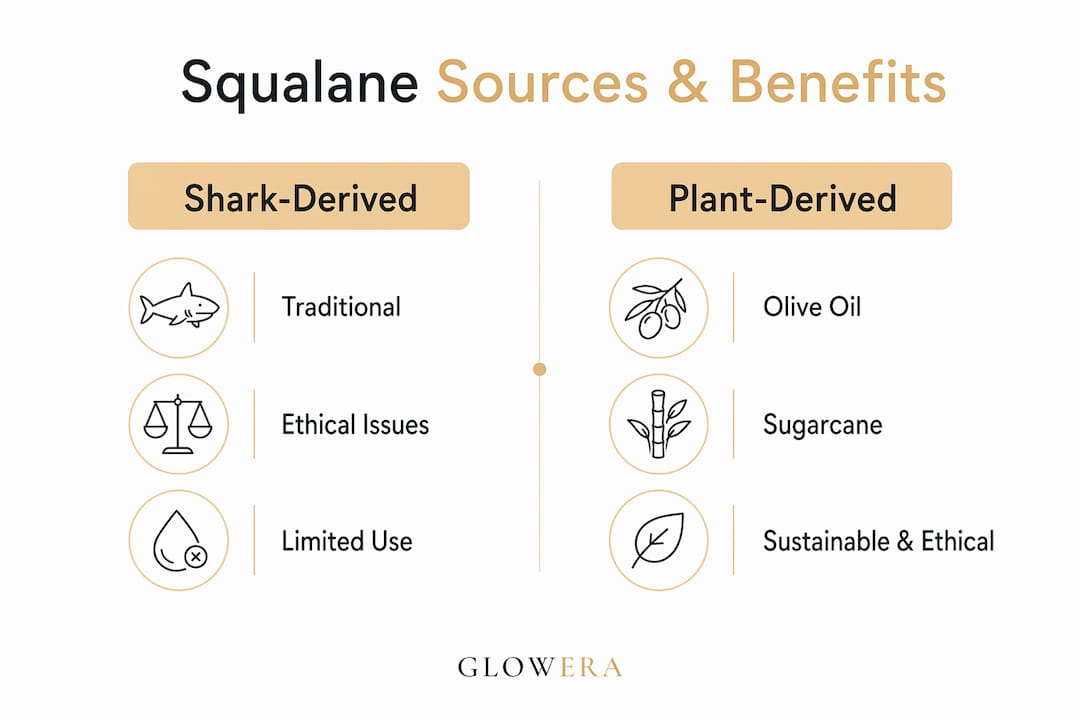
Traditional squalane production required harvesting shark liver oil, specifically from deep-sea sharks such as the gulper shark. The liver of a single deep-sea shark can contain up to 80% squalene by weight, which made sharks an efficient industrial source. The ecological consequences, however, are significant. Deep-sea sharks reproduce slowly and are highly vulnerable to overfishing, meaning demand from the cosmetics industry contributed directly to population decline.

The good news is that the industry has largely moved on. Squalene can be derived from plants including olives, sugarcane, and wheat, and these sources now dominate the market. Plant-based squalane from olive oil, sugarcane, and biotech sources is the standard in Europe and Japan, with most major cosmetics manufacturers having transitioned away from shark-derived material.
How to identify ethical sourcing on product labels
Sharkproject, a conservation organisation, runs a campaign called “Contains Shark. Know Your Choice.” The campaign advocates for mandatory labelling so that consumers can identify when a product contains shark-derived ingredients and choose alternatives. Without clear labelling, it is genuinely difficult to know whether the squalane in your serum came from a plant or a shark.
Here is how to check:
- Look for “plant-derived squalane” on the label or in the brand’s ingredient transparency notes. This phrase confirms a non-animal source.
- Check the brand’s sourcing policy. Reputable brands publish their ingredient origins, particularly those with sustainable beauty practices as a core value.
- Avoid products listing “shark liver oil” or “shark squalene” as a distinct ingredient. These are direct indicators of animal-derived sourcing.
- Contact the brand directly if the label is ambiguous. Brands committed to ethical sourcing will answer clearly.
- Use third-party databases such as INCI Decoder or EWG’s Skin Deep to cross-reference ingredient origins before purchasing.
Sourcing transparency is not just an ethical consideration. It reflects a brand’s broader commitment to quality and accountability, which matters when you are investing in premium skincare.
Are other shark-derived compounds effective in skincare?
Beyond squalane, the term “shark beauty” sometimes appears alongside other shark-derived substances, most commonly shark cartilage and shark liver oil. The evidence for these in topical skincare is considerably weaker.
Shark cartilage contains chondroitin sulphate, a compound widely studied for joint health and osteoarthritis support. Research confirms that shark cartilage is primarily relevant for joint support, not for topical skin benefit. Applying chondroitin to the skin surface does not replicate the systemic effects seen in oral supplementation, and no robust clinical evidence supports its use as a topical anti-ageing agent.
Shark liver oil contains alkylglycerols and squalene, compounds with potential immunomodulatory properties. Some preliminary research suggests anti-inflammatory activity, but evidence for specific skin benefits from topical shark liver oil remains limited and inconclusive. Claims that shark liver oil reverses ageing or repairs sun damage are not supported by peer-reviewed dermatological data.
Why misleading claims matter
Mixing evidence from joint health research with topical skincare claims is a common source of consumer confusion. A compound that works orally for one purpose does not automatically translate into a topical skin benefit. Applying knowledge about the intended use of shark cartilage and liver oil is the clearest way to avoid being misled by marketing language.
Key points to keep in mind:
- Squalane has strong, consistent evidence for barrier support and hydration.
- Shark cartilage and chondroitin are not proven for topical skin use.
- Shark liver oil shows potential anti-inflammatory effects but lacks skin-specific clinical trials.
- Ingredient claims should always be matched to the route of administration (topical vs. oral).
Pro Tip: When a product claims to use “shark extract” or “marine collagen from shark,” ask the brand to specify the exact compound and cite the clinical evidence for topical use. Vague marine sourcing language is often a marketing choice rather than a scientific one.
How does shark beauty compare to broader marine skincare trends?
Ocean-inspired beauty is a much wider category than shark-derived ingredients alone. Marine skincare draws from seaweed, algae, sea kelp, and ocean minerals, many of which have strong evidence for hydration, firming, and antioxidant activity. The appeal is partly scientific and partly aesthetic. The association with clean, mineral-rich ocean water resonates with consumers seeking natural, sustainable beauty practices.
Brands like OSEA Malibu have built their entire identity around seaweed-derived hydration and ocean body care without using any shark ingredients. Their approach demonstrates that ocean-inspired beauty does not require animal-derived compounds to be effective or commercially successful.
The table below clarifies the key differences between shark-derived and broader marine beauty:
| Category | Source | Primary Skin Benefit | Sustainability Status |
|---|---|---|---|
| Squalane (plant) | Olive, sugarcane, wheat | Barrier repair, hydration | High: widely available, renewable |
| Squalane (shark) | Shark liver oil | Barrier repair, hydration | Low: ecological impact, slow-reproducing species |
| Seaweed extract | Brown, red, green algae | Antioxidant, firming, hydration | High: fast-growing, ocean-farmed |
| Shark cartilage | Shark skeleton | Joint support (oral) | Low: limited topical evidence, animal-derived |
| Ocean minerals | Sea salt, marine clay | Detoxifying, soothing | High: mineral-rich, sustainably harvested |
The distinction between thematic marketing and ingredient reality matters here. A product labelled “ocean-inspired” may contain no marine ingredients at all. Conversely, a product with genuine seaweed extracts or plant-derived squalane delivers real, evidence-backed benefits. Reading the INCI list, not the front-of-pack imagery, is always the more reliable guide. For those interested in clean beauty ingredient transparency, the distinction between marketing language and formulation reality is a recurring theme worth understanding.
Key takeaways
Squalane is the only shark-derived skincare ingredient with strong clinical evidence, and plant-based versions now make shark sourcing both unnecessary and avoidable.
| Point | Details |
|---|---|
| Squalane is the key ingredient | It is the only shark-derived compound with consistent clinical evidence for skin barrier repair and hydration. |
| Plant sources now dominate | Olive, sugarcane, and wheat-derived squalane is the industry standard in Europe and Japan, replacing shark liver sources. |
| Other shark compounds lack topical proof | Shark cartilage and shark liver oil are not clinically proven for topical skin benefits. |
| Label literacy protects your choices | Look for “plant-derived squalane” and avoid vague “shark extract” claims without cited evidence. |
| Marine beauty extends beyond sharks | Seaweed, algae, and ocean minerals offer well-evidenced, sustainable alternatives to shark-derived ingredients. |
What i have learnt from years of watching the shark beauty conversation
The phrase “shark beauty” generates genuine curiosity, and I understand why. There is something compelling about the idea of ingredients drawn from one of the ocean’s most resilient creatures. But after years of following ingredient science and consumer trends, my honest view is this: the most interesting thing about shark beauty is not the shark. It is the squalane, and specifically, the fact that we no longer need sharks to produce it.
What concerns me more than the ingredient itself is the marketing language that surrounds it. I have seen products use “shark” as a brand signal, implying potency or rarity, without disclosing whether the compound is animal-derived or plant-based. That ambiguity is not accidental. Sharkproject’s labelling campaign exists precisely because transparency is not yet the default, and that should give every informed consumer pause.
My practical advice is simple. If a product lists squalane and you care about sourcing, contact the brand and ask. If they cannot tell you whether it is plant-derived, that tells you something important about their commitment to ingredient honesty. The Shark Beauty range at Glowera is worth exploring for context on how the brand name is used in the beauty tech space, separate from ingredient sourcing questions.
The broader lesson is that ocean-inspired beauty is genuinely exciting, and it does not require exploitation to be effective. Seaweed extracts, algae-based actives, and plant-derived squalane all deliver real results. The ocean offers enough without taking from its most vulnerable inhabitants.
— Adam
Explore ethical and science-backed skincare at Glowera
If this article has prompted you to think more carefully about what goes into your skincare, the next step is choosing devices and products that are backed by evidence rather than marketing imagery.
Glowera’s curated selection of K-beauty tech devices includes tools from brands like Medicube, FOREO, and NuFACE, all chosen for their clinical credibility and results-driven design. Whether you are interested in microcurrent lifting, LED light therapy, or advanced cleansing technology, Glowera offers professional-grade options for home use in the UAE. Every product on the platform is authenticated and supported by detailed guidance, so you can invest with confidence rather than guesswork.
FAQ
What is squalane and is it always from sharks?
Squalane is a hydrogenated lipid used as a skin emollient. It was traditionally sourced from shark liver oil but is now predominantly derived from plants such as olive, sugarcane, and wheat.
How do i know if my squalane is plant-derived?
Check the product label or brand website for the phrase “plant-derived squalane.” Sharkproject recommends mandatory labelling so consumers can identify and avoid animal-sourced versions.
Does shark cartilage benefit the skin when applied topically?
No robust clinical evidence supports topical skin benefits from shark cartilage. Research shows it is primarily relevant for joint health when taken orally, not for skincare applications.
Is squalane safe for sensitive or acne-prone skin?
Yes. Squalane is confirmed as non-comedogenic and hypoallergenic by the Cosmetic Ingredient Review, making it suitable for sensitive, oily, and acne-prone skin types.
What marine ingredients are effective alternatives to shark-derived compounds?
Seaweed extracts, algae-based actives, and ocean minerals offer well-evidenced hydration, antioxidant, and firming benefits without any animal-derived sourcing concerns.