Most beauty devices you encounter operate on a single frequency, and that single setting limits how deeply and broadly the treatment can reach your skin. Understanding why beauty devices use dual frequencies changes how you evaluate every device on the market. Rather than heating or stimulating just one tissue layer, dual-frequency technology targets several layers simultaneously, producing collagen and elastin responses that a single frequency simply cannot replicate. For UAE residents navigating a wide and often confusing selection of advanced beauty tech, this distinction is not a minor technical footnote. It is the difference between results that plateau and results that genuinely progress.
Table of Contents
- Understanding dual frequencies in skincare devices
- How dual frequencies improve treatment safety and effectiveness
- Dual frequencies in ultrasound and radiofrequency devices: a comparison
- Maximising results with dual-frequency beauty devices: practical tips
- Why dual-frequency technology is the future of beauty devices
- Explore dual-frequency beauty devices at Glowera UAE
- Frequently asked questions
Key Takeaways
| Point | Details |
|---|---|
| Dual frequencies target multiple skin depths | Using two frequencies allows beauty devices to treat both superficial and deeper skin layers simultaneously for better rejuvenation. |
| Enhanced treatment safety | Dual-frequency modes reduce risks like pigmentation worsening and support safe use on darker skin types common in the UAE. |
| Broader clinical applications | They treat various skin issues including laxity, pigmentation, and vascular conditions effectively in a single session. |
| Optimised results over time | Collagen and skin elasticity improvements peak several weeks to months after treatment with lasting benefits. |
| Expert care maximises outcomes | Following recommended pre- and post-treatment steps enhances safety and prolongs treatment effectiveness. |
Understanding dual frequencies in skincare devices
At its core, radiofrequency (RF) beauty technology works by delivering electromagnetic energy into skin tissue, creating controlled heat that triggers collagen remodelling. The frequency at which that energy is delivered determines where in the skin the heat concentrates.
A device operating at 2 MHz generates energy that penetrates more broadly and deeply, reaching the adipose (fat) tissue layer beneath the dermis. A device operating at 6.78 MHz produces more localised heating concentrated along the fibrous septa, the connective tissue bands that run through the skin’s structure. These two frequencies do entirely different jobs, which is precisely why combining them matters.
Dual-frequency RF creates pronounced thermal reactions at the dermosubcutaneous junction, the boundary between the dermis and the subcutaneous layer, simultaneously enhancing collagen and elastin remodelling in a way neither frequency achieves alone. This is the scientific basis for why beauty devices use dual frequencies rather than defaulting to a single setting.
Key mechanisms dual-frequency RF exploits:
- Deeper thermal reach at 2 MHz activates fibroblasts in the lower dermis and adipose tissue
- Superficial fibrous remodelling at 6.78 MHz contracts the connective tissue bands closer to the skin’s surface
- Combined heating zone at the dermosubcutaneous junction produces a more thorough collagen stimulus
- Fat preservation because the heat profile avoids the sustained temperatures required for adipocyte (fat cell) death, maintaining facial volume while still tightening skin
You can explore how these mechanisms apply across at-home and professional-grade RF and EMS technologies to find devices that suit your treatment goals. The benefits of dual frequency in beauty devices stem directly from this layered approach. Rather than forcing users to choose between surface-level and deep treatment, a dual-frequency device handles both in a single session, which is a genuine clinical advantage. Broader exposure to cellular rejuvenation therapies continues to validate the principle that multi-depth stimulation produces superior tissue responses.
How dual frequencies improve treatment safety and effectiveness
Safety is where dual-frequency technology separates itself most decisively from single-frequency alternatives, particularly for the UAE population, which spans a wide range of Fitzpatrick skin types (the clinical scale used to classify skin’s response to UV exposure, from Type I pale skin to Type VI deeply pigmented skin).

Continuous wave RF, the mode most single-frequency devices rely on, heats tissue broadly and without discrimination. In darker skin tones, this indiscriminate heating risks worsening hyperpigmentation (dark patches) by triggering excess melanin production. Pulsed wave RF, by contrast, delivers energy in short bursts that specifically target abnormal blood vessels and pigment clusters without prolonged epidermal exposure.
Dual wave RF microneedling safely treats Fitzpatrick skin types III to VI by minimising epidermal thermal damage, making it effective for pigment and vascular conditions including melasma and rosacea. For a region where Fitzpatrick types III through VI represent a significant portion of the population, this is not a minor benefit. It is the reason dual-frequency technology in skincare is gaining traction in UAE clinics and among at-home users alike.
The clinical data on skin elasticity reinforces this further. Dual-fusion RF improves cheek dermis and fascia elasticity, with peak effects measured at day 21 post-treatment and results consistent across different gender and age groups. Clinicians can reliably predict outcomes because the response is not dependent on individual biological variance in the way single-frequency treatments can be.
Benefits worth noting:
- Treats vascular conditions (rosacea, broken capillaries) and pigmentation (melasma) in the same device
- Reduces the risk of post-inflammatory hyperpigmentation in darker skin types
- Measurably improves skin elasticity in both the dermis and the deeper fascia layer
- Consistent outcomes across age demographics, making it suitable for a broader patient base
Pro Tip: If you are researching safe home microneedling options, look specifically for devices that offer both pulsed and continuous wave modes. This combination gives you the flexibility to address vascular and pigment concerns before tackling collagen remodelling in the same treatment plan.
Dual frequencies in ultrasound and radiofrequency devices: a comparison
Dual-frequency technology is not exclusive to RF devices. Ultrasound-based beauty tools use the same principle of pairing frequencies, though the physical mechanism and target tissue layers differ meaningfully.
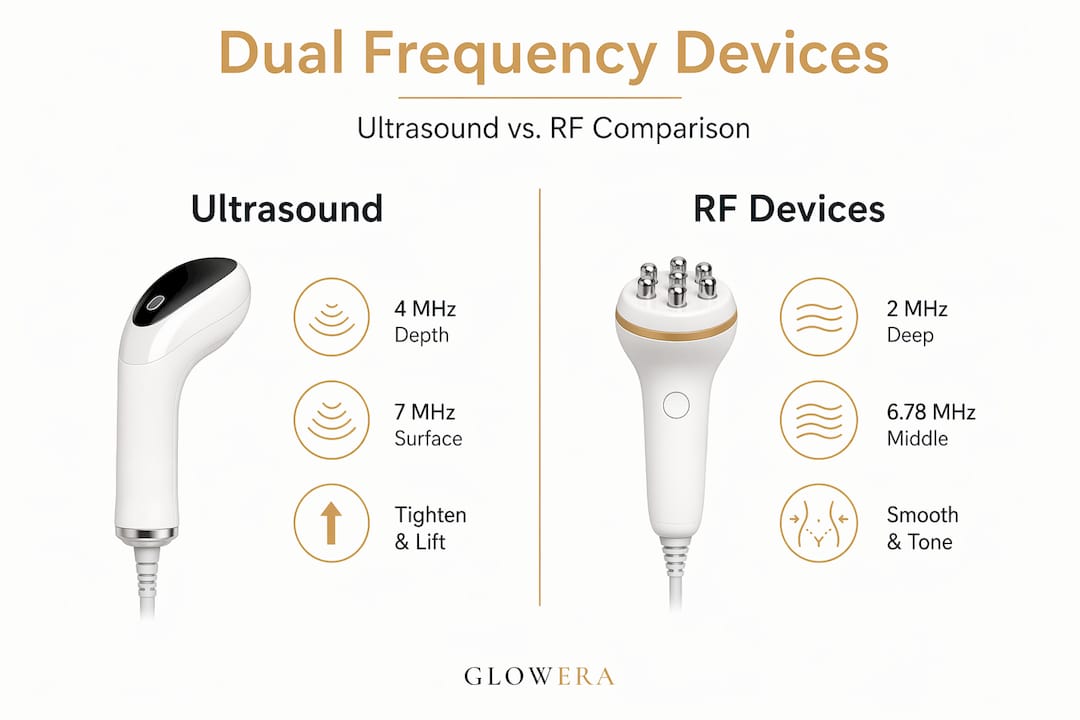
In ultrasound therapy, 4 MHz targets the deep SMAS layer (the superficial muscular aponeurotic system, which is the fibromuscular network beneath the fat layer often addressed in surgical facelifts), while 7 MHz focuses on the superficial dermis for collagen contraction closer to the skin’s surface. Together, they replicate a layered lift that historically required surgical intervention.
In RF devices, dual-frequency RF at 6.78 MHz and 2 MHz delivers simultaneous skin tightening at multiple tissue depths, offering advantages that single-frequency RF cannot match. The XERF device, for example, has drawn attention for this capacity to address both shallow and deep tissue in one pass.
| Feature | Dual-frequency ultrasound | Dual-frequency RF |
|---|---|---|
| Frequencies used | 4 MHz and 7 MHz | 2 MHz and 6.78 MHz |
| Primary deep target | SMAS muscle layer | Adipose tissue and dermis junction |
| Primary surface target | Superficial dermis | Fibrous septa in upper dermis |
| Main effect | Structural lifting and collagen contraction | Collagen and elastin remodelling |
| Key consideration | Pressure and applicator angle critical | Session spacing and SPF aftercare important |
| Suitable for | Significant laxity, jawline definition | General tightening, pigment and vascular treatment |
Both approaches benefit from how dual frequencies enhance beauty devices by addressing tissue at different depths within a single treatment. The practical implication for users is that neither technology is universally superior. Ultrasound dual-frequency suits those targeting structural laxity and jawline definition. RF dual-frequency suits those prioritising collagen quality, skin tone evenness, and conditions like melasma.
For those interested in bringing professional-grade results home, the CurrentBody RF skin tightening device is a well-regarded option in the UAE market. Achieving these results also connects to the broader field of advanced aesthetic medicine, where layered treatment approaches are now considered standard clinical practice.
Maximising results with dual-frequency beauty devices: practical tips
Understanding the technology is only half the equation. Getting the most from a dual-frequency device requires consistent, informed use. The following steps apply whether you are using an at-home device or following up after a professional treatment.
-
Pause retinoids one week before treatment. Retinoids thin the skin’s outer layer, increasing sensitivity to heat and energy. Suspending them reduces the risk of irritation and redness during and after your session.
-
Apply high-SPF sunscreen daily post-treatment. Your skin is actively remodelling collagen in the weeks after a session. UV exposure during this period can interfere with that process and worsen any existing pigmentation. SPF 50 is the minimum for UAE conditions.
-
Space sessions 4 to 8 weeks apart. Collagen remodelling is a biological process that takes time. Treating too frequently does not accelerate results; it can cause cumulative irritation. Plan for 3 to 6 months before assessing your full outcome.
-
Use pulsed wave mode before continuous wave in RF microneedling. Pulsed wave applied first addresses vascular and pigment concerns with minimal thermal spread. Following with continuous wave for collagen remodelling then works on already-cleared tissue for better overall results.
-
Control applicator pressure and timing in ultrasound treatments. Consistent pressure ensures the transducer (the energy-emitting head) maintains proper contact with skin, which is essential for reaching both SMAS and superficial dermis layers predictably.
-
Use cooled treatment gel post-session. Applying cooling gel immediately after reduces redness and surface inflammation. Given the UAE climate, where ambient heat can slow skin recovery, this step carries more practical weight than it might in cooler regions.
Pro Tip: Results from dual-frequency RF peak three to six months post-treatment, with younger skin typically maintaining effects longer. Do not judge your device by results at four weeks. Photograph your skin in consistent lighting at the start and again at the three-month mark for an accurate comparison.
The advantages of dual frequency beauty tools are fully realised only with this kind of disciplined approach. For a broader foundation in at-home energy treatments, the microcurrent skincare guide offers useful context on building a technology-led skincare routine.
Why dual-frequency technology is the future of beauty devices
There is a persistent assumption in the aesthetics world that effective body and face contouring requires destroying fat cells. Cryolipolysis (fat freezing), certain laser protocols, and high-intensity focused treatments all operate on the premise that removing volume produces better definition. Dual-frequency RF challenges this directly.
Dual-frequency approaches stimulate extensive extracellular matrix remodelling without adipocyte loss, which means the structural improvement comes from the quality of the tissue itself, not the reduction of volume beneath it. In facial treatments especially, preserving fat while remodelling the collagen framework produces a more natural and longer-lasting contour. Devices that destroy fat in the face often produce a hollowed appearance over time. Dual-frequency collagen stimulation avoids this entirely.
For UAE residents specifically, the safety profile across diverse skin phototypes makes dual-frequency technology not just preferable but arguably essential. Clinicians and at-home users in this region cannot afford to work with devices that are effective only on lighter skin tones. The ability to treat melasma, rosacea, and general laxity across Fitzpatrick types III through VI in a single device category is a clinical achievement with direct relevance here.
There is also the matter of value. A device that treats vascular issues, pigmentation, and collagen loss eliminates the need for three separate treatment modalities. That consolidation benefits both clinics managing diverse clientele and consumers building a home skincare device collection. For further reading on bringing professional facial devices into your routine, Glowera’s educational resources cover this territory thoroughly.
Frequency modulation in beauty devices will continue to advance. But dual-frequency devices, as they exist today, already represent a meaningful step beyond what single-frequency tools can achieve. Investing in them now means your skincare technology is aligned with where clinical aesthetics is heading, not where it has been.
Explore dual-frequency beauty devices at Glowera UAE
Now that you understand how dual frequencies enhance beauty devices and why they deliver superior results across skin types and treatment goals, the next step is finding the right device for your specific needs.
Glowera’s curated range of K-beauty tech devices includes options built around dual-frequency technology for both at-home and professional-level results. The Medicube AGE-R Booster Pro combines microcurrent with dual RF frequencies, making it a strong choice for those targeting skin rejuvenation and firmness simultaneously. For radiofrequency-specific tightening, the CurrentBody RF skin tightening device delivers professional-grade energy in a format designed for consistent home use. Every device available through Glowera is authentic, backed by UAE-compatible warranty and delivery, and supported by a team that can guide your selection with confidence.
Frequently asked questions
Why do some beauty devices use two different frequencies instead of one?
Dual frequencies allow devices to target multiple skin layers simultaneously, producing broader and deeper thermal effects that improve collagen remodelling and skin tightening more effectively than a single frequency. Combining 2 MHz and 6.78 MHz creates pronounced thermal reactions at multiple skin depths, enhancing both collagen and elastin remodelling in a single session.
Are dual-frequency devices safe for darker skin tones like those common in the UAE?
Yes, devices with pulsed wave modes selectively target pigment and blood vessels to minimise epidermal heating, reducing risks such as post-inflammatory hyperpigmentation common with single continuous wave devices. Dual wave RF microneedling safely treats Fitzpatrick skin types III to VI by minimising epidermal damage.
How soon can one expect to see results from dual-frequency skin treatments?
Visible improvements typically peak between three to six months after treatment, with collagen remodelling continuing throughout this period. Results from dual-frequency RF show that younger skin may maintain effects for longer, making early investment in treatment worthwhile.
Can dual-frequency beauty devices treat conditions like melasma and rosacea effectively?
Yes, pulsed wave RF selectively targets abnormal blood vessels and pigment clusters, enabling safe treatment of melasma and rosacea, particularly in darker skin types. Pulsed wave RF targeting causes less thermal spread than continuous wave, making these conditions treatable in Fitzpatrick types III to V with reduced side-effect risk.
How do dual frequencies in ultrasound devices compare to those in radiofrequency devices?
Ultrasound devices pair 4 MHz for deep SMAS layer targeting with 7 MHz for superficial dermis collagen contraction, while RF devices combine 2 MHz and 6.78 MHz to heat multiple tissue depths via electromagnetic rather than acoustic energy. Ultrasound and RF dual-frequency approaches both achieve layered skin rejuvenation but through distinct physical mechanisms suited to different treatment goals.