
A return policy for skincare devices is the formal agreement defining your right to refund, exchange, or trial a device within a set period. Understanding why return policy matters for skincare devices is not a minor detail. It is the single most important factor separating a confident purchase from a costly mistake. 93% of consumers review a retailer’s return policy before buying, and 68% call it decisive in choosing where to shop. For high-value beauty technology like microcurrent tools, LED light therapy masks, and K-beauty devices, that scrutiny is fully justified.
Why are return policies for skincare devices uniquely important?
Skincare devices carry a level of purchase risk that most consumer electronics do not. A pair of wireless headphones delivers results within minutes. A NuFACE microcurrent device or a Dr. Dennis GROSS LED mask requires weeks of consistent use before visible skin improvements appear. That gap between purchase and proof is where return policies become critical.
Skincare devices require 30–90 days of testing due to the slow rate of skin cellular turnover. Collagen remodelling, tone improvement, and texture refinement all operate on biological timescales that no retailer’s standard 14-day window can accommodate. A return policy that does not reflect this reality leaves buyers financially exposed.

The distinction between a warranty and a return policy also matters here. A warranty covers manufacturing defects. A return policy covers your right to change your mind or judge a device unsuitable. Many buyers conflate the two, only to discover their device is covered for faults but not for underperformance. Understanding both protections is non-negotiable before committing to any purchase.
Key risks that make return policies especially important for beauty devices:
- High unit cost. Devices from brands like FOREO, ZIIP, and CurrentBody regularly retail above AED 500, making a non-refundable purchase a significant financial loss.
- Slow visible results. Skin biology, not marketing timelines, dictates when results appear. A 14-day window is rarely sufficient.
- Technical complexity. Devices using radiofrequency, microcurrent, or LLLT (low-level light therapy) require correct usage protocols. Buyer error during a short trial period should not forfeit the right to return.
- Opened device restrictions. Many retailers refuse returns on used devices, leaving buyers stuck if the product proves unsuitable after first use.
Pro Tip: Before purchasing any skincare device, confirm explicitly whether the retailer accepts returns on opened or used products. A policy that only covers sealed items offers almost no real protection for beauty technology.
How do return policy terms affect satisfaction and trust?
Not all return policies are equal. The specific clauses within a policy determine whether it genuinely protects the buyer or merely creates the appearance of doing so.
Restocking fees are one of the most common hidden costs. Return policies with restocking fees of 10–25% are standard across many beauty device retailers. On a AED 1,200 device, a 15% restocking fee means you absorb AED 180 simply for exercising your right to return. That is not a risk-free trial. It is a partial refund dressed as consumer protection.
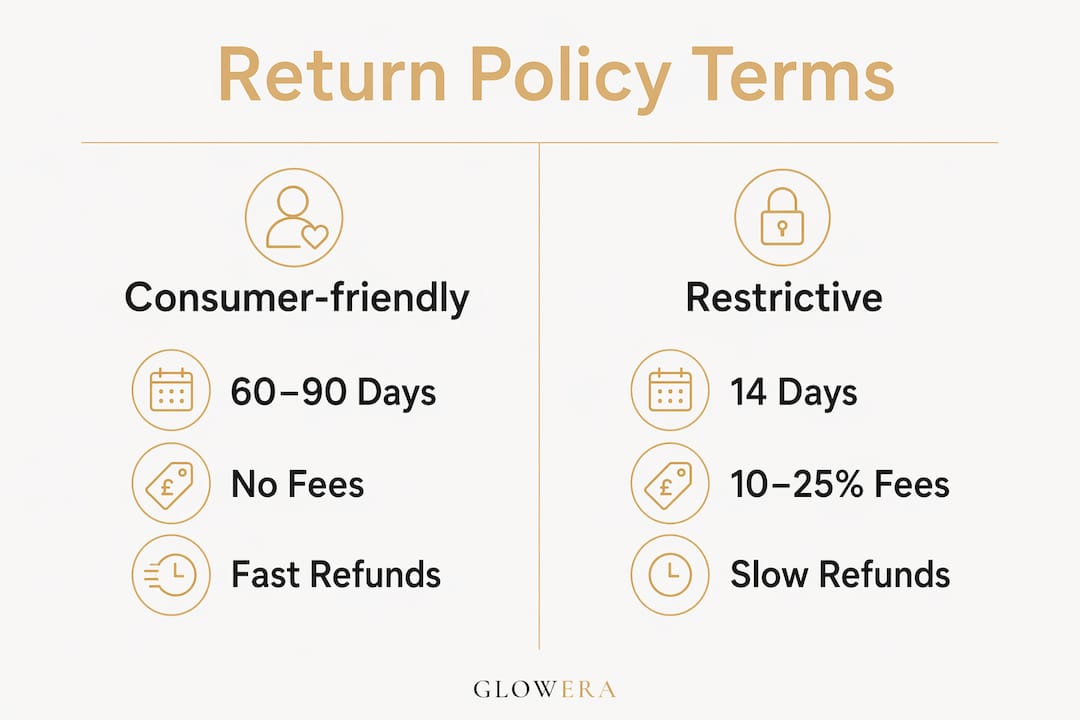
Refund processing time is equally significant. Slow refunds create a period of doubt that leads 43% of shoppers to avoid a brand entirely. Faster refund processing is directly correlated with higher customer retention. A retailer that takes 10 business days to process a refund signals operational friction that erodes trust well beyond the single transaction.
The table below compares common return policy terms and their practical impact on buyers of skincare devices.
| Policy term | Consumer-friendly version | Restrictive version |
|---|---|---|
| Trial window | 60–90 days | 14 days or fewer |
| Opened device returns | Accepted with conditions | Refused entirely |
| Restocking fee | None | 10–25% of purchase price |
| Return shipping cost | Covered by retailer | Paid by buyer |
| Refund processing time | 3–5 business days | Up to 10 business days |
Pro Tip: Always calculate the true cost of a return before purchasing. Add the restocking fee and return shipping to the device price. If the total financial risk exceeds your comfort level, choose a retailer with more generous terms.
What should you check before buying a skincare device?
Evaluating a return policy before purchase is a structured process, not a quick scan of the returns page. The following checklist covers every clause that matters for beauty technology buyers.
-
Confirm the trial window length. A minimum of 30 days is the industry standard. 60–90 days is the recommended window for devices requiring observation of skin improvements. Any window shorter than 30 days is inadequate for most skincare technology.
-
Clarify the opened device rule. Ask the retailer directly whether a device can be returned after first use. Many policies state “unused and in original packaging” as a condition. For a skincare device, that condition makes the return policy functionally useless.
-
Calculate all cost liabilities. Identify whether return shipping is at your expense, whether a restocking fee applies, and how long the refund will take. These three factors determine the real cost of exercising a return.
-
Distinguish warranty from return coverage. Confirm the warranty period separately. A 12-month warranty from NuFACE or FOREO covers defects. It does not cover your right to return a device you find ineffective. Both protections must be in place.
-
Verify the seller’s after-sales support. Purchasing from third-party retailers without local service can result in unclaimed warranties and unresolved post-purchase issues. Retailers with local UAE service networks offer measurably better protection. Glowera’s after-sales service guide for UAE buyers covers this in detail.
-
Read the exclusions carefully. Some policies exclude specific device categories, such as LED masks or radiofrequency tools, from standard return terms. Exclusions are rarely highlighted in marketing materials.
How do transparent return policies build brand trust?
A return policy is a brand signal before it is a legal document. The terms a retailer publishes communicate how much confidence they have in their own products and how much they value the buyer’s experience after the sale.
A transparent and fair return policy is one of the most effective trust-building mechanisms available to any retailer. Brands that manage returns openly, rather than restrictively, retain customers at a significantly higher rate. The logic is straightforward: a generous return policy removes the fear of commitment. Buyers who feel protected are more likely to purchase, and more likely to return.
The opposite is equally true. 67% of consumers avoid brands after a negative return experience. A single difficult return can permanently end a customer relationship that might otherwise have spanned years and multiple device purchases.
“A return policy is not a cost centre. It is a retention tool. Brands that treat returns as service recovery rather than loss management build the kind of loyalty that no advertising budget can replicate.”
The beauty device market in the UAE is growing, and with it, consumer expectations around after-sales service. Brands like CurrentBody and FOREO have built strong reputations partly on the strength of their return and trial policies. Buyers in the UAE now compare these terms as carefully as they compare device specifications. Retailers who treat their return policy as an afterthought will lose buyers to those who treat it as a commitment.
Key takeaways
A return policy for skincare devices is a direct measure of purchase risk: the more generous and transparent the terms, the safer and more confident your buying decision.
| Point | Details |
|---|---|
| Trial window length | Require a minimum 30-day window; 60–90 days is the standard for devices needing skin cycle observation. |
| Opened device returns | Confirm the retailer accepts used devices; policies covering sealed items only offer no real protection. |
| Hidden costs | Calculate restocking fees and return shipping before buying to understand the true cost of a return. |
| Warranty vs return policy | Treat these as separate protections; a warranty covers defects, not suitability or performance. |
| Seller trustworthiness | Buy from retailers with local UAE service networks to protect both your return rights and warranty claims. |
Return policies and the reality of skin biology
I have reviewed hundreds of skincare device purchases over the years, and the single most common regret I hear is not about the device itself. It is about the return window. Buyers invest in a NuFACE Trinity or a CurrentBody LED panel, use it correctly for three weeks, see no dramatic change, and then discover their 14-day return window has already closed.
The frustration is entirely avoidable. Skin does not respond to technology on a retailer’s schedule. Cellular turnover, collagen synthesis, and pigmentation correction all operate on timescales of four to twelve weeks. A return policy that does not account for this is not designed with the buyer in mind. It is designed to limit liability. You can read more about how wearable skincare tech testing periods align with real skin result timelines.
The other pitfall I see consistently is buyers conflating warranty and return coverage. They assume that because a device carries a 24-month warranty, they are protected if it underperforms. They are not. A warranty is a defect guarantee. A return policy is a satisfaction guarantee. You need both, and you need to verify both before handing over payment. Retailers who make this distinction clear in their terms are the ones worth trusting.
— Adam
Skincare devices at Glowera: shop with confidence
Glowera stocks a curated range of professional-grade skincare devices from brands including NuFACE, FOREO, Dr. Dennis GROSS, ZIIP, and CurrentBody, all available with transparent return terms and local UAE after-sales support.
Whether you are considering K-beauty tech devices from Medicube or exploring LED light therapy options, every purchase at Glowera comes with clear trial conditions, warranty documentation, and a support team based in the UAE. The return and warranty terms are stated plainly on every product page, so you know exactly what protection you have before you buy. Buying a skincare device is a considered decision. Glowera is built to make that decision straightforward.
FAQ
Why does a return policy matter more for skincare devices than other products?
Skincare devices require 30–90 days of use before results become visible. A standard 14-day return window does not give buyers enough time to evaluate performance, making a generous return policy a genuine necessity rather than a bonus.
What is the difference between a warranty and a return policy for beauty devices?
A warranty covers manufacturing defects for a set period. A return policy covers your right to return a device if it is unsuitable or unsatisfactory. Both protections are separate and both are necessary.
Are restocking fees common on skincare device returns?
Yes. Restocking fees of 10–25% are common in the beauty device market. Always check for these fees before purchasing, as they reduce the actual refund you receive.
Can I return a skincare device after using it once?
This depends entirely on the retailer’s policy. Many retailers only accept returns on sealed, unused devices. Before buying, confirm in writing whether opened or used devices are eligible for return.
How do I verify a retailer’s return policy is reliable in the UAE?
Check whether the retailer has a local UAE service network, clear written return terms on their website, and documented warranty fulfilment. Buying from retailers without local support significantly increases the risk of unresolved post-purchase issues.