
Titanium spheres are defined as solid, precision-engineered metal components used as contact points, rollers, and conductive elements in professional-grade beauty devices. They appear in microcurrent tools, facial rollers, and compressive massage devices because titanium combines exceptional corrosion resistance with mechanical durability that lower-grade metals simply cannot match. Understanding why titanium spheres are used in beauty devices means understanding one core principle: the material touching your skin directly affects both the device’s lifespan and your skin’s safety. Glowera’s skincare technology guide covers how material choices shape device performance across every major category.
Why are titanium spheres used in beauty devices?
Titanium spheres are used in beauty devices because they resist corrosion, conduct low-level electrical current reliably, and maintain a smooth surface that does not irritate skin. These three properties work together to make titanium the preferred material for contact components in professional skincare tools.
The corrosion resistance is the most critical factor. Conductive gels, serums, and moisture create an electrolytic environment on the skin’s surface. Solid titanium resists galvanic corrosion in these conditions, while chrome or nickel-coated alternatives degrade over time. Degraded coatings release metal ions onto the skin, which can cause irritation and reduce device efficacy.
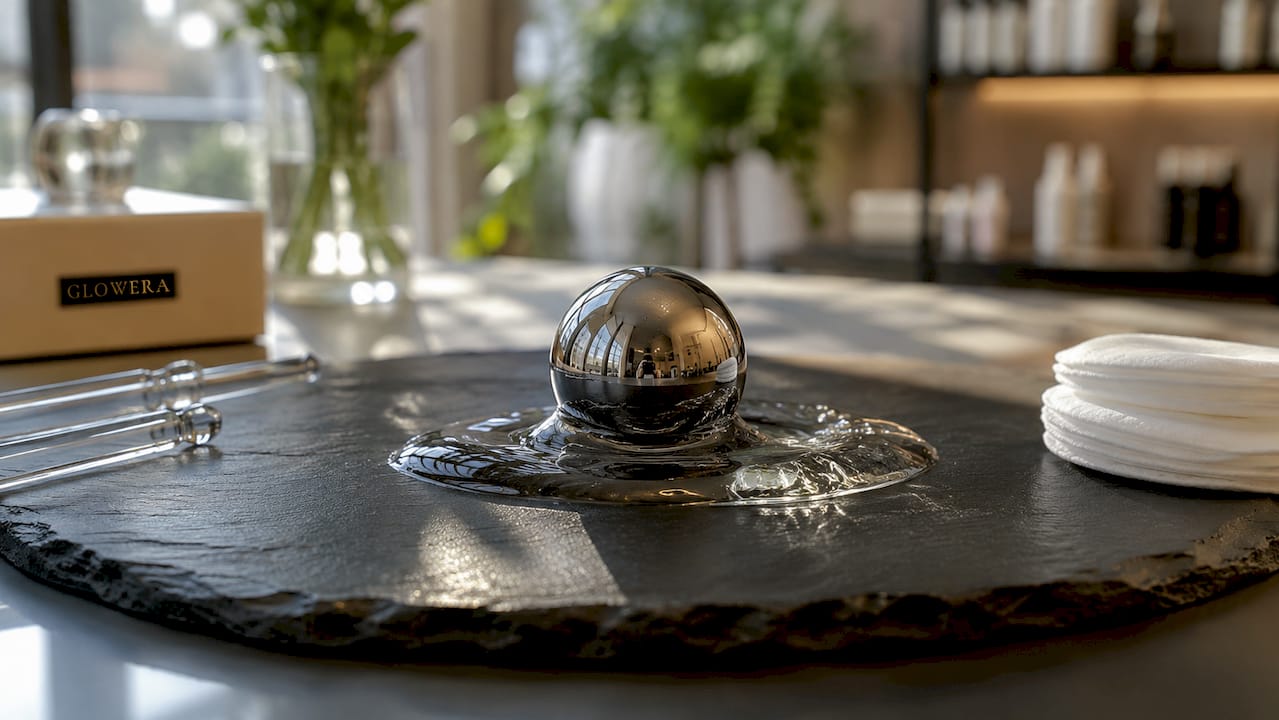
Titanium is also classified as a biologically inert metal. This means it does not react with skin tissue, making it suitable for repeated contact with sensitive facial skin. The same property that makes titanium safe for surgical implants makes it reliable for daily skincare use.
The sphere shape itself matters too. A polished spherical surface distributes pressure evenly across the skin. This reduces friction during gliding motions and prevents localised discomfort that flat or irregular contact points can cause.
Key material properties at a glance
- Corrosion resistance: Titanium withstands prolonged exposure to conductive gels and moisture without oxidising.
- Biocompatibility: As a biologically inert metal, titanium does not trigger skin reactions under normal use conditions.
- Strength-to-weight ratio: Titanium’s lightweight nature reduces hand fatigue during extended treatment sessions.
- Surface smoothness: A polished titanium sphere minimises friction and glides cleanly across the skin.
- Electrical stability: Titanium provides stable low-current contacts without the oxidation degradation seen in cheaper metals.
Pro Tip: When assessing a beauty device, check whether the contact spheres are described as solid titanium or simply “titanium-finished.” Solid titanium maintains its properties throughout the component’s life; a thin coating does not.
What mechanical and electrical roles do titanium spheres perform?
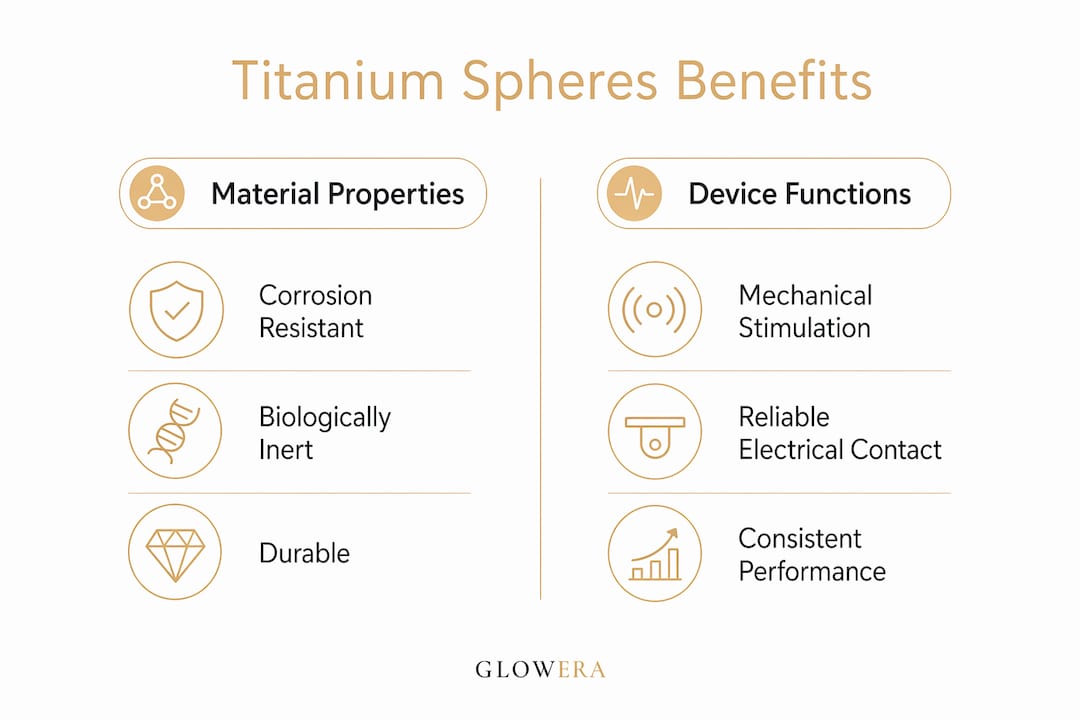
Titanium spheres perform two distinct functions in skincare tools: mechanical stimulation and electrical contact. Understanding both roles clarifies why the material choice matters so much.
Electrical contact in microcurrent devices
Microcurrent devices deliver low-level electrical current to facial muscles to stimulate tone and circulation. The spheres act as the electrodes that transfer this current from the device to the skin. Titanium provides stable low-current electrical contacts because its corrosion resistance prevents the oxidation layer that forms on cheaper metals. An oxidised electrode creates inconsistent current delivery, which reduces treatment effectiveness.
Copper conducts electricity more efficiently than titanium, but copper oxidises rapidly in moist environments. Titanium’s lower conductivity is an acceptable trade-off because microcurrent devices operate at very low current levels where consistency matters more than raw conductivity.
Mechanical stimulation in massage and roller devices
In facial rollers and compressive massage tools, titanium spheres deliver rhythmic mechanical pressure to the skin. A patented 55-sphere roller system demonstrates how precision-engineered sphere arrays deliver uniform pressure and rhythmic compression that aid circulation, lymphatic drainage, and contour refinement. The key word here is “uniform.” Inconsistent pressure creates uneven treatment results.
The numbered sequence below shows how sphere design, surface texture, and energy application interact in a well-engineered device:
- Sphere configuration determines coverage area and pressure distribution across the treatment zone.
- Surface texture controls the friction coefficient between the sphere and skin, affecting glide quality and stimulation depth.
- Energy application (electrical current or vibration) is delivered through or alongside the sphere contact point.
- Sealed gasket systems protect internal electronics from moisture ingress, complementing titanium’s natural resistance to extend device lifespan.
- Synergistic design of all four elements drives consistent aesthetic outcomes across treatment sessions.
The interaction between sphere surface texture and energy delivery is particularly important. A rough or degraded surface disrupts the energy transfer pattern, reducing the precision of each treatment. Titanium’s hardness means the surface retains its finish far longer than softer metals.
How do titanium spheres differ from titanium dioxide in skincare?
This is one of the most common points of confusion for skincare enthusiasts. Titanium spheres and titanium dioxide are both derived from titanium, but they serve entirely different purposes and appear in entirely different product types.
Titanium dioxide (TiO2) is a chemical compound used as a UV filter in sunscreens and as a pigment in cosmetics. It is a fine powder incorporated into formulations, not a structural component. Titanium spheres, by contrast, are solid mechanical parts machined to precise dimensions and used in devices.
| Feature | Titanium spheres | Titanium dioxide (TiO2) |
|---|---|---|
| Form | Solid metal component | Fine chemical powder |
| Function | Mechanical and electrical contact | UV filter and pigment |
| Found in | Beauty devices and tools | Sunscreens and cosmetics |
| Skin contact | Direct, repeated physical contact | Applied in formulation |
| Regulatory context | Materials engineering standards | Cosmetic ingredient regulations |
The practical implication is straightforward. When a device is described as using titanium, it refers to the structural metal. When a sunscreen lists titanium dioxide, it refers to a chemical UV filter. Mixing up these two uses leads to misplaced concerns about device safety or, conversely, false assumptions about a sunscreen’s mechanical properties.
High-end beauty devices favour solid titanium or stainless steel contact points over plated base metals precisely because the structural integrity of the component determines device performance. TiO2 in a serum has no bearing on whether a device’s electrodes will corrode.
How to care for and choose devices with titanium spheres
Proper care extends the functional lifespan of any beauty device, and titanium sphere components are no exception. The material is durable, but the surrounding device architecture requires attention.
Maintenance best practices
- Clean immediately after use: Wipe off conductive gel immediately after each session. Gel left on the spheres accelerates wear on any surrounding non-titanium components.
- Store away from humidity: Keep devices in a dry environment. Moisture affects internal electronics even when the titanium spheres themselves remain unaffected.
- Avoid harsh cleaning agents: Use a soft, damp cloth. Abrasive cleaners can scratch polished surfaces and reduce glide quality over time.
- Inspect the gasket seal: Check that the seal around the spheres remains intact. A compromised gasket allows moisture to reach internal electronics.
What to look for when purchasing
Budget devices often use thin metal coatings over base metals. These coatings degrade quickly with repeated exposure to electrolyte gels, causing corrosion and potential skin irritation. Solid titanium components maintain their properties throughout the device’s life.
When evaluating a device, look for explicit confirmation that the contact spheres are solid titanium rather than titanium-plated. Reputable brands specify this in their product descriptions. Devices with sealed gasket systems around the sphere housing offer an additional layer of protection for internal components.
Pro Tip: Check the third-party testing credentials of any device before purchasing. Independent testing confirms material claims and validates safety standards that manufacturers state in their marketing.
The long-term value of a titanium sphere device is higher than a coated-metal alternative. The upfront cost is greater, but the material’s durability means fewer replacements and more consistent treatment results over time.
Key takeaways
Titanium spheres are the preferred contact material in professional beauty devices because their corrosion resistance, biocompatibility, and mechanical durability directly determine both device longevity and treatment consistency.
| Point | Details |
|---|---|
| Corrosion resistance is critical | Solid titanium withstands conductive gels and moisture without degrading, unlike coated metals. |
| Dual function in devices | Titanium spheres serve as both electrical contacts in microcurrent tools and mechanical stimulators in rollers. |
| Not the same as titanium dioxide | TiO2 is a chemical UV filter; titanium spheres are solid structural components with entirely different roles. |
| Solid beats coated | Solid titanium maintains its properties throughout a device’s life; thin coatings corrode and irritate skin. |
| Care extends lifespan | Cleaning immediately after use and storing away from humidity protects both the spheres and internal electronics. |
The material question most buyers overlook
When people ask me about beauty devices, the conversation almost always focuses on the technology: microcurrent, LED wavelengths, radiofrequency. The material the device is made from rarely comes up. That is a mistake, and I have seen it cost people money.
I have reviewed devices across a wide price range, and the single most reliable indicator of long-term performance is the contact material. A device with a sophisticated electrical system but low-grade coated metal spheres will degrade within months of regular use. The coating wears, the base metal oxidises, and the treatment consistency drops. The technology becomes irrelevant when the contact point fails.
What I find particularly interesting is how materials engineering standards from aerospace and medical device manufacturing have quietly shaped beauty tech design. The same corrosion resistance standards that make titanium suitable for surgical implants are now applied to facial devices. That crossover is not marketing language. It reflects genuine materials science applied to a consumer product category.
My honest view is that the industry has not done enough to educate buyers on this point. Most product descriptions lead with the treatment outcome and bury the material specification in a technical footnote. Buyers deserve to know that a solid titanium contact sphere is a fundamentally different component from a titanium-finished one. The microcurrent devices category is where this distinction matters most, because the electrode material directly affects current delivery.
The next wave of beauty device design will likely focus on material combinations: titanium spheres paired with advanced surface coatings that enhance conductivity without sacrificing corrosion resistance. That is the direction materials engineering is heading, and it will produce more effective devices at more accessible price points.
— Adam
Glowera’s range of devices with premium titanium components
Glowera curates beauty technology devices built to professional standards, including tools where titanium sphere components are central to their performance.
The microcurrent devices at Glowera feature solid titanium contact spheres that deliver consistent low-current stimulation for facial toning and lifting. Each device in the range is selected for material quality, not just treatment claims. For those interested in K-beauty technology that incorporates premium contact materials, Glowera’s K-beauty tech collection includes tools from globally trusted brands with verified material specifications. Every product listed on Glowera comes with full brand authentication, so the material claims you read are the materials you receive.
FAQ
What are titanium spheres in beauty devices?
Titanium spheres are solid, precision-machined metal components used as contact points, electrodes, or rollers in beauty devices. They provide corrosion-resistant, biocompatible surfaces that deliver consistent mechanical or electrical stimulation to the skin.
Why is titanium preferred over other metals in skincare tools?
Titanium resists corrosion from conductive gels and moisture, remains biologically inert against skin tissue, and maintains a smooth surface finish over time. Budget alternatives using coated metals degrade quickly and can cause skin irritation.
Are titanium spheres the same as titanium dioxide in skincare?
No. Titanium spheres are solid structural metal components in devices. Titanium dioxide is a chemical compound used as a UV filter in sunscreens and cosmetics. The two forms of titanium serve entirely different functions.
How do I know if a device uses solid titanium or just a titanium coating?
Check the product specification for the phrase “solid titanium” rather than “titanium-finished” or “titanium-coated.” Reputable brands state this explicitly. Third-party testing credentials provide additional confirmation of material claims.
How should I clean titanium sphere beauty devices?
Wipe off conductive gel immediately after each use with a soft, damp cloth. Store the device in a dry environment and avoid abrasive cleaning agents that can scratch the polished sphere surface.