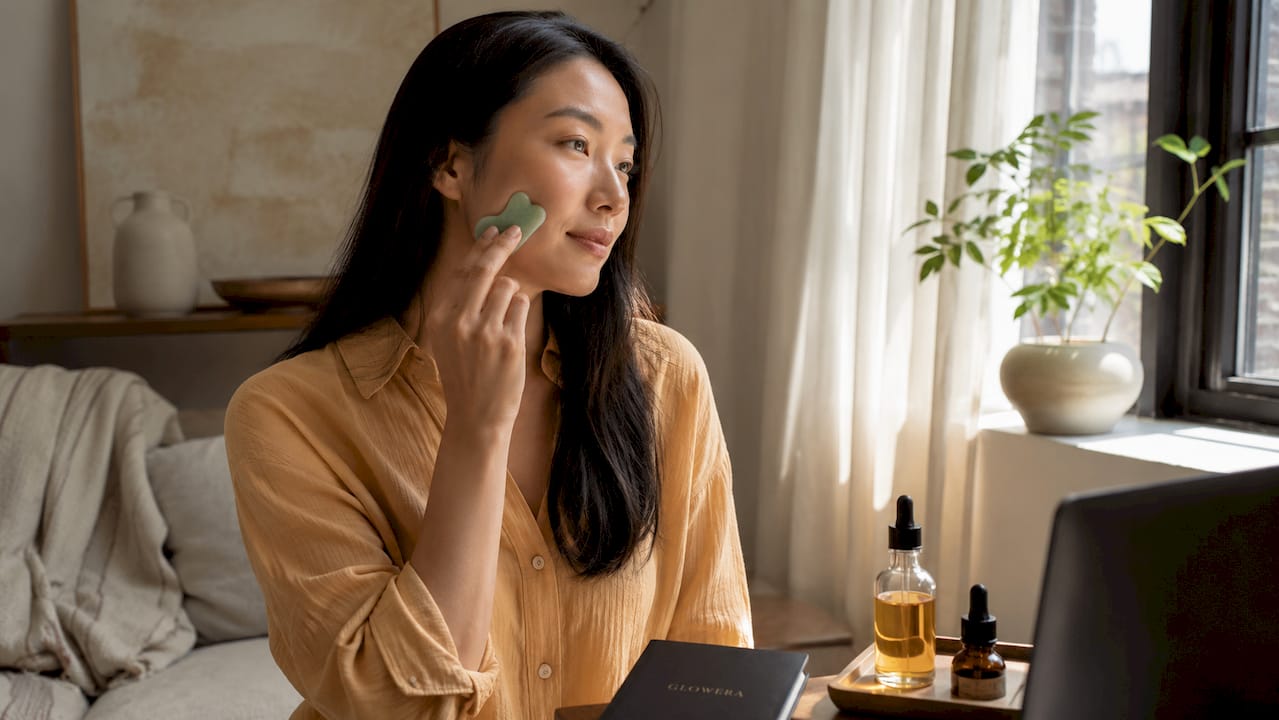
Third-party testing for beauty devices is defined as independent verification of a device’s safety, performance, and clinical claims by a laboratory or certification body with no commercial stake in the outcome. This process sits at the heart of responsible beauty technology. Without it, consumers and skincare professionals have only manufacturer marketing to rely on. The role of third-party testing in beauty devices covers everything from electrical safety audits to peer-reviewed clinical trials, and understanding it separates genuinely validated products from well-packaged noise. Brands like NuFACE, FOREO, and CurrentBody operate in a market where independent oversight is increasingly non-negotiable, and regulators on both sides of the Atlantic are tightening requirements fast.
What safety standards does third-party testing verify in beauty devices?
Third-party safety testing verifies that a beauty device will not harm the person using it. This is not a formality. Devices that emit radiofrequency energy, laser light, or electrical microcurrent carry real risks if their output is uncontrolled.
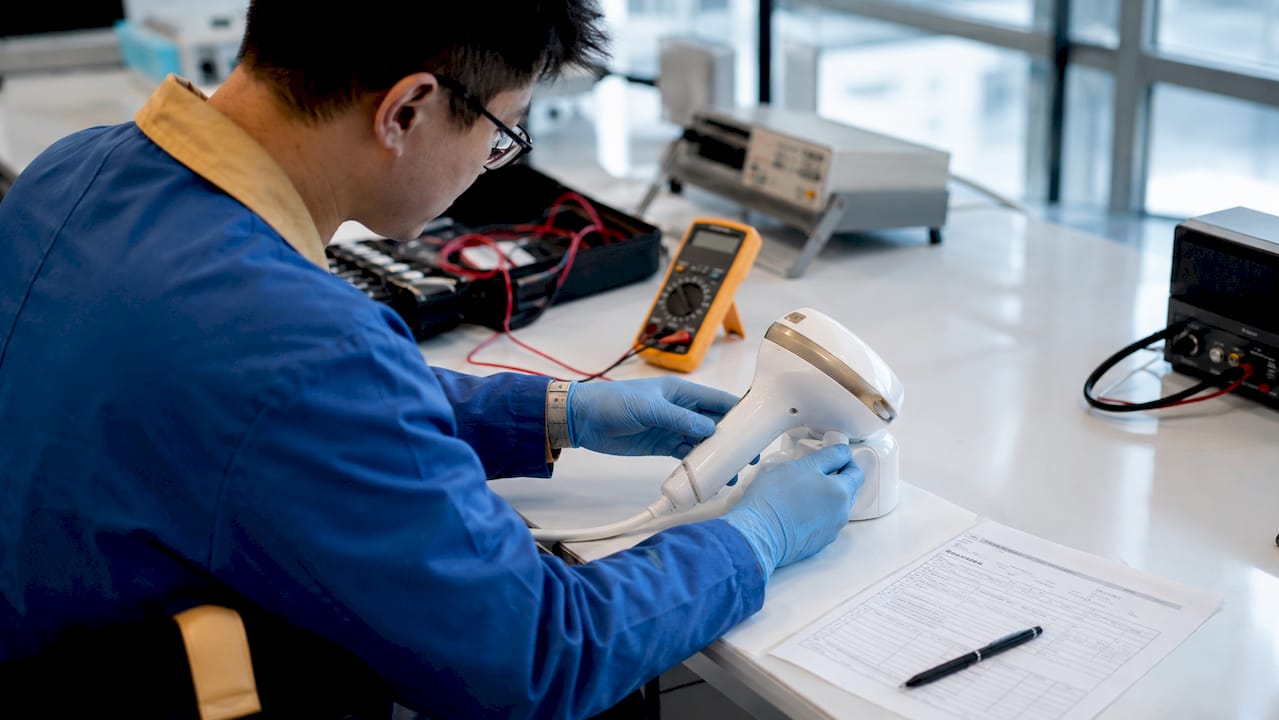
The most widely applied standard is IEC 60601-1-2, which covers electromagnetic compatibility and electrical safety for medical and aesthetic devices. Compliance with this standard is mandatory for FDA 510(k) clearance in the United States and CE marking in the European Union. Both marks confirm that an independent body has tested the device, not merely that the manufacturer has declared it safe.
Third-party labs also test for:
- Thermal safety: Confirming the device surface does not exceed safe temperature thresholds during extended use.
- Radiation output: Verifying that LED, laser, or radiofrequency emissions stay within permitted limits.
- Electrical insulation: Checking that no current leakage reaches the user’s skin.
- Material biocompatibility: Confirming that components contacting skin do not cause irritation or toxicity.
The difference between US and EU certification is worth noting. FDA 510(k) clearance requires a device to demonstrate substantial equivalence to a predicate device already on the market. CE marking under the EU Medical Device Regulation (EU MDR) requires a clinical evaluation and, for higher-risk devices, a notified body audit. Neither process accepts manufacturer self-declaration alone.
Pro Tip: Look for the CE mark, FDA clearance number, or a named testing laboratory on the product packaging or the brand’s website. If none of these appear, the safety claim is unverified.
How does independent clinical testing validate device efficacy?
Safety certification confirms a device will not harm you. Clinical efficacy testing confirms it will actually do what the brand claims. These are two entirely separate processes, and many devices pass one without the other.
Clinical efficacy testing specific to beauty devices follows a structured process:
- Device-specific trial design. The study must test the exact device being sold, at the exact parameters used in practice. A study on 630nm red light in general does not validate a specific LED mask operating at 633nm.
- Controlled methodology. Valid trials use control groups, blinding where possible, and objective measurement tools such as corneometers for hydration or ultrasound for collagen density.
- Peer review and publication. Results published in indexed journals carry far greater weight than internal white papers or brand-commissioned summaries.
- Transparent funding disclosure. Studies funded entirely by the manufacturer require independent replication before they can be considered conclusive.
- Relevant endpoints. Meaningful outcomes include measurable changes in skin elasticity, transepidermal water loss, or collagen density, not subjective satisfaction scores alone.
The critical distinction is between general technology studies and device-specific clinical data. Brands frequently cite published research on microcurrent or photobiomodulation as a category, then imply their specific device produced those results. That is a misleading conflation. Valid efficacy requires controlled, peer-reviewed studies measuring parameters on the marketed device itself.
Clinical study validation is the standard that separates professional-grade devices from consumer gadgets with attractive packaging.
Pro Tip: Ask the brand for the full clinical study, not a summary. Check that the study names the specific device model, lists the testing institution, and was published in a peer-reviewed journal.
What certifications and lab reports indicate a trustworthy beauty device?
Not all certification marks carry equal weight. The difference between a self-attestation badge and a fully audited certification is significant, and consumers deserve to know which is which.
Common third-party certifications
EWG Verified and COSMOS impose ingredient restrictions and transparency requirements that exceed basic government regulations. They are particularly relevant for devices that incorporate topical formulations or conductive gels. The V-Label goes further by verifying entire supply chains, including raw materials and processing aids, rather than testing a single finished product.
Self-attestation versus audited certification
Some certification marks rely on self-attestation questionnaires completed by the brand, with no onsite audit. PETA’s cruelty-free mark operates on this basis. V-Cert audits, by contrast, involve physical supply chain verification. For consumers prioritising ethical sourcing, the distinction matters considerably.
What a credible lab report contains
Detailed third-party lab reports include the laboratory’s name and accreditation number, a unique report reference, the date of testing, the specific standard applied, and the measured results against pass/fail criteria. A report missing any of these elements cannot be independently verified.
Certification comparison
| Certification | Scope | Audit type | Relevant to devices |
|---|---|---|---|
| CE marking | Safety and performance | Notified body audit | Yes, mandatory for EU market |
| FDA 510(k) | Safety and equivalence | FDA review | Yes, mandatory for US market |
| EWG Verified | Ingredient safety | Third-party review | Partially, for gel-based devices |
| COSMOS | Formulation and sourcing | Full audit | Partially, for hybrid products |
| V-Label | Vegan supply chain | Onsite audit | Yes, for ethical sourcing claims |
| PETA cruelty-free | Animal testing policy | Self-attestation | Limited, no onsite verification |
How can you assess the credibility of third-party testing claims?
Credible brands disclose their testing openly. Brands with weak or absent evidence rely on vague language and impressive-sounding references that do not hold up to scrutiny.
When reviewing a device, check for the following:
- Named laboratory: The testing lab should be identified by name, not described generically as “an independent laboratory.”
- Specific device model: The report or study must reference the exact product being sold, including its model number and output parameters.
- Date of testing: Reports older than five years may not reflect the current production version of the device.
- Standard applied: The specific IEC, ISO, or FDA standard tested should be stated explicitly.
- Accessible documentation: Credible brands publish lab reports or clinical study abstracts on their website or provide them on request.
Common red flags include phrases such as “clinically inspired,” “dermatologist-approved” without named clinicians, or citations of general scientific literature with no device-specific data. Misleading efficacy claims are widespread in the beauty device market. Brands cite scientific literature on general technology but fail to provide evidence specific to their device’s unique parameters.
Skincare professionals recommending devices to clients carry a duty of care. Checking device authenticity before recommending a product protects both the client and the professional’s credibility.
Pro Tip: Search the FDA’s 510(k) database using the brand name or device type. If the device claims FDA clearance but does not appear in the database, the claim is false.
What regulatory trends are shaping beauty device testing in 2026?
The regulatory environment for beauty devices is tightening, particularly for devices incorporating artificial intelligence or algorithm-driven skin analysis.
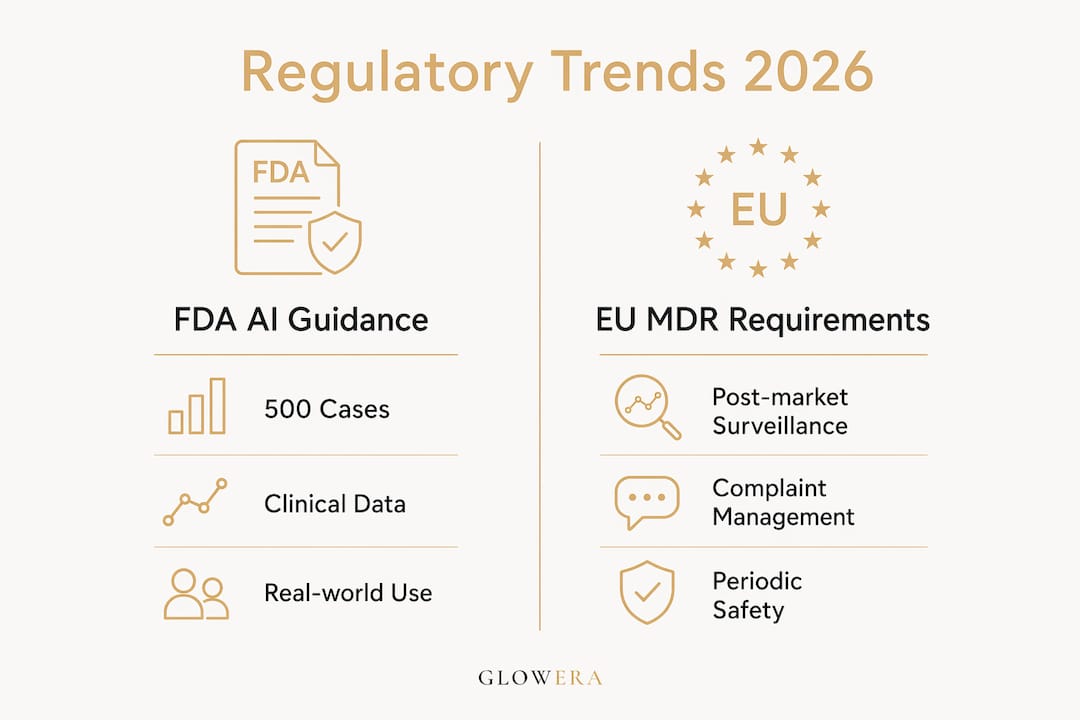
The FDA’s new draft guidance requires AI-powered beauty devices to provide clinical correlation data based on at least 500 real-world cases. This covers endpoints such as transepidermal water loss improvement and collagen density changes. The implication is clear: a device that analyses skin and recommends a treatment protocol must now demonstrate its recommendations produce measurable outcomes in a substantial patient population.
Under EU MDR, aesthetic devices face mandatory post-market surveillance. This includes complaint management and periodic safety updates that confirm ongoing device performance, not just pre-launch testing. A device that passes certification at launch must continue to meet standards throughout its commercial life.
| Regulatory development | Market | Key requirement | Impact on testing |
|---|---|---|---|
| FDA AI device draft guidance | United States | ≥500 real-world cases for clinical validation | Raises evidence threshold significantly |
| EU MDR post-market surveillance | European Union | Ongoing complaint tracking and safety updates | Extends testing beyond product launch |
| FDA 510(k) clearance | United States | Substantial equivalence to predicate device | Requires independent lab verification |
| EU CE marking | European Union | Notified body audit for higher-risk devices | Mandates third-party involvement |
Real-world data is becoming central to regulatory compliance. Manufacturers can no longer rely solely on controlled pre-market trials. Ongoing performance data from actual users is now part of the evidence base regulators expect.
Key takeaways
Third-party testing is the only reliable mechanism for separating verified beauty device claims from marketing assertions, and regulatory bodies in both the US and EU are making independent validation a legal requirement.
| Point | Details |
|---|---|
| Safety and efficacy are separate | A device can pass electrical safety testing and still lack clinical proof of its skincare claims. |
| Certification depth varies | Audited marks like V-Cert and CE marking carry more weight than self-attestation badges like PETA’s cruelty-free mark. |
| Device-specific data is non-negotiable | General technology studies do not validate a specific device; only trials on the exact marketed product count. |
| Regulatory standards are rising | FDA draft guidance now requires at least 500 real-world cases for AI device clinical validation. |
| Professionals carry a duty of care | Skincare professionals recommending devices should verify lab reports and certifications before advising clients. |
Why I think the industry’s testing problem is bigger than most realise
The beauty device market has a credibility gap that third-party testing alone cannot fully close, because the gap is partly cultural. Brands have trained consumers to accept “clinically inspired” as equivalent to “clinically proven.” Most people do not know to ask for a lab report number, let alone how to verify one.
Working closely with beauty technology for years, I have seen devices from well-regarded brands that carry impressive-sounding certifications but cannot produce a single peer-reviewed study on their specific product. The certifications are real. The efficacy claims are not supported. These are two entirely different things, and the marketing deliberately blurs the line.
The FDA’s move toward requiring 500 real-world cases for AI device validation is the most significant shift I have seen in this space. It forces manufacturers to generate genuine population-level data, not just a well-designed pilot study with 30 participants. That is a meaningful change, and it will separate serious brands from those relying on regulatory ambiguity.
For skincare professionals, my practical advice is this: treat device selection the same way you would treat ingredient selection. Demand the primary source. If a brand cannot provide a named lab, a report number, and a peer-reviewed study on the specific device, the evidence does not exist. Recommending an unverified device to a client is a professional risk that no amount of attractive packaging justifies.
The brands getting this right, including those stocking devices with genuine IEC compliance documentation and published clinical data, are the ones worth recommending. The rest are selling confidence, not results.
— Adam
Glowera’s approach to verified beauty technology
Glowera curates beauty technology devices that meet or exceed independent testing requirements, so you are not left deciphering certification claims on your own.
Every device in Glowera’s catalogue, from K-beauty tech tools including Medicube’s clinically studied devices to LED light therapy panels from CurrentBody, is selected with safety certification and clinical evidence as baseline criteria. Glowera’s editorial content, including detailed product descriptions and scientific guides, gives you the documentation context to make informed decisions. For skincare professionals and consumers in the UAE seeking verified, professional-grade devices, Glowera is the starting point.
FAQ
What does third-party testing mean for beauty devices?
Third-party testing means an independent laboratory, with no commercial interest in the outcome, verifies a device’s safety, performance, and clinical claims. It differs from manufacturer self-declaration because the testing body has no incentive to overlook failures.
Are beauty devices tested independently before sale?
Not always. Safety certification such as CE marking or FDA 510(k) clearance requires independent verification, but clinical efficacy claims are frequently based on general technology studies rather than device-specific trials.
What certifications should I look for on a beauty device?
CE marking and FDA 510(k) clearance confirm safety and regulatory compliance. For ethical sourcing, look for audited marks such as V-Label or COSMOS rather than self-attestation badges.
How does the FDA’s 2026 guidance affect AI beauty devices?
The FDA’s draft guidance requires AI-powered beauty devices to provide clinical validation data from at least 500 real-world cases, covering measurable endpoints such as collagen density changes and transepidermal water loss improvement.
How can I verify a brand’s third-party testing claims?
Request the full lab report, confirm the testing laboratory is named and accredited, and search the FDA’s 510(k) database if the brand claims US clearance. A credible brand will provide this documentation without hesitation.